
Risk Communication

The practice of presenting the results from the first four risk management steps to the relevant business stakeholders and gathering their views on the potential uncertainties.

Key Points

  • Shares outcomes from early risk activities (identify, analyze, prioritize, and plan responses) with the right stakeholders.
  • Tailors messages so stakeholders understand key risks, their drivers, impacts, and proposed responses.
  • Seeks stakeholder perceptions, concerns, and thresholds to validate assumptions and refine analysis.
  • Creates a feedback loop that can adjust risk priorities and response strategies.

Example

In an agile program integrating a new payment gateway, the product manager presents a brief risk summary: top fraud, compliance, and performance risks; their likelihood and impact; and draft mitigation actions. She then asks compliance, security, and marketing leads for their views and thresholds, capturing their feedback to update the risk register and response plans.

PMP Example Question

During release planning, the project manager reviews identified risks, the results of qualitative analysis, and proposed responses, then asks business leaders for their views on likelihood and impact. What process is being performed?

  1. Risk Communication
  2. Identify Risks
  3. Monitor Risks
  4. Plan Risk Responses

Correct Answer: A — Risk Communication

Explanation: The scenario describes sharing risk findings with stakeholders and soliciting their perceptions, which is the essence of risk communication.
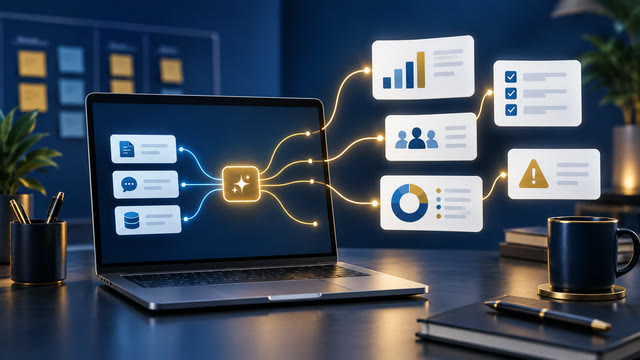
AI Systems with Claude, for Scrum Masters and Project Managers

Most AI pilots in project management do not fail on the model. They fail because somebody pointed the thing at a decision instead of at a task. This course is built around that distinction, and around the work that follows once you get it right.

Eight teaching sections, taught against one running project from the first lecture to the last. You watch a system get built, then you build the same one against your own sprint. Nothing here is a demo that works only on the example.

You finish with five working systems and you keep them. The sprint report machine turns your board export and standup notes into the report you currently write by hand. The retro intelligence system tells you what the team keeps saying, not just what it said this time. The stakeholder comms engine drafts the update in the register the audience expects. The backlog health monitor flags the quiet decay nobody has time to check for. The risk and dependency tracker follows the chains that actually bite.

Seventy-six working files ship with it, across four sections, so every system is built against real sprint data rather than material invented for a slide. Four sprints of retrospectives, board exports, standup notes, backlog and risk data.

Explore the Course


Take Control of Project Performance!

HK School of Management and Technology helps you go beyond status reports and gut feelings. In this advanced course, you will learn Earned Value Management (EVM) to measure progress, forecast outcomes, and take corrective action. Learn how WBS quality drives performance, how control accounts work, and how to use EAC, TCPI, and variance analysis. Practical skills, tools, and guidance you can apply right away. Covered by Udemy's 30-day refund policy.

Learn More